Smooth Council Approvals
Submit DA paperwork that meets all local planning scheme requirements the first time.
Formal, comprehensive tree reports by an AQF Level 5 qualified arborist.
Providing expert consulting across Kings Meadows and Greater Launceston.
Whether you are planning a new build or need to prove a tree is dead or dying to council, our Arborist Report Kings Meadows service delivers the rigorous documentation you need.
In Kings Meadows, if a tree triggers the Natural Assets Code or sits within a heritage area, the City of Launceston will almost always require a written report from a suitably qualified arborist before approving removal or significant building works.
Submit DA paperwork that meets all local planning scheme requirements the first time.
Independent, documented evidence for neighbour disputes or insurance claims.
Implement effective tree protection zones to keep heritage or feature trees alive during construction.
We discuss your project requirements and the specific council codes involved.
Our AQF5 arborist conducts a thorough on-site evaluation of the trees.
We compile data on species, health, structure, and retention value.
You receive a comprehensive, formalized document ready for submission.
When managing established trees, planning a new development, or addressing safety concerns on your property, securing a professional Arborist Report Kings Meadows is your first critical step. At Launceston Arborist, our consulting team provides the exact documentation required by builders, property managers, and the City of Launceston to keep your project moving smoothly.
Kings Meadows and its surrounding suburbs feature a unique mix of remnant native eucalypts like white gum and black peppermint, alongside grand exotic plantings such as English oak and silver birch. Whether you are sub-dividing a block, extending your home, or worried about a declining tree near your roofline, our AQF Level 5 consulting arborists deliver clear, objective, and authoritative assessments.
We understand the local landscape and the Tasmanian Planning Scheme inside out. Our reports are designed to protect your assets, ensure public safety, and satisfy regulatory requirements without unnecessary delays. When you work with us, you are dealing directly with a local team of arboriculture professionals who know the climate, the soils, and the specific council codes of the Launceston region.
A common mistake homeowners and developers make is relying on under-qualified trades or DIY assessments to judge tree health or development impacts. An arborist report written by someone without an AQF Level 5 Diploma in Arboriculture is routinely rejected by the City of Launceston. This instantly stalls Development Applications (DAs), leading to costly project delays, holding charges, and the frustration of having to commission a second, proper report.
Another significant risk is poorly specified tree protection. If an under-qualified assessor fails to accurately calculate the Tree Protection Zone (TPZ) or Structural Root Zone (SRZ) under AS4970, your builders might inadvertently sever critical roots. This can cause a healthy, mature tree to become structurally unstable, creating a massive safety hazard when Launceston’s strong spring winds hit, and potentially exposing you to legal liability or council fines.
Our team solves this by providing precise, science-backed, and fully compliant documentation. We do the job right the first time. Our AQF Level 5 consulting arborists conduct thorough Visual Tree Assessments (VTA) and map accurate root zones, ensuring your builder has a workable plan and council has exactly what they need to grant approval.
Our consulting arborists produce several types of reports tailored to your specific project needs. Every report is drafted to precise industry and local government standards.
We compile comprehensive reports required for DAs under the Tasmanian Planning Scheme. This includes full tree inventories, species identification, DBH (Diameter at Breast Height) measurements, and Safe Useful Life Expectancy (SULE) ratings. We outline strict retention recommendations and provide AS4970-compliant Tree Protection Zones for the site plan.
Utilising Visual Tree Assessment (VTA) methodologies, we document structural defects, decay, and potential target zones. We assess the likelihood and consequence of failure, which is crucial for pre-purchase property inspections, neighbour disputes, or managing duty-of-care for strata properties and schools.
We deliver detailed construction phase instructions. This specifies exact fencing requirements, root mapping protocols, mulch protection depths, and designated supervised work zones to ensure retained trees survive excavation and building works unharmed.
When a tree falls under the Natural Assets Code or Local Historic Heritage Code, we provide the evidence required for its removal. We document intractable disease, irreversible structural decline, or unacceptable safety risks, alongside appropriate replanting recommendations.
We have streamlined our reporting process to make it as simple and transparent as possible for Kings Meadows homeowners and developers. The first step is an initial consultation. We discuss your project brief—whether it is a simple hazard assessment or a complex multi-lot subdivision—and determine exactly what type of report the council or your insurer requires.
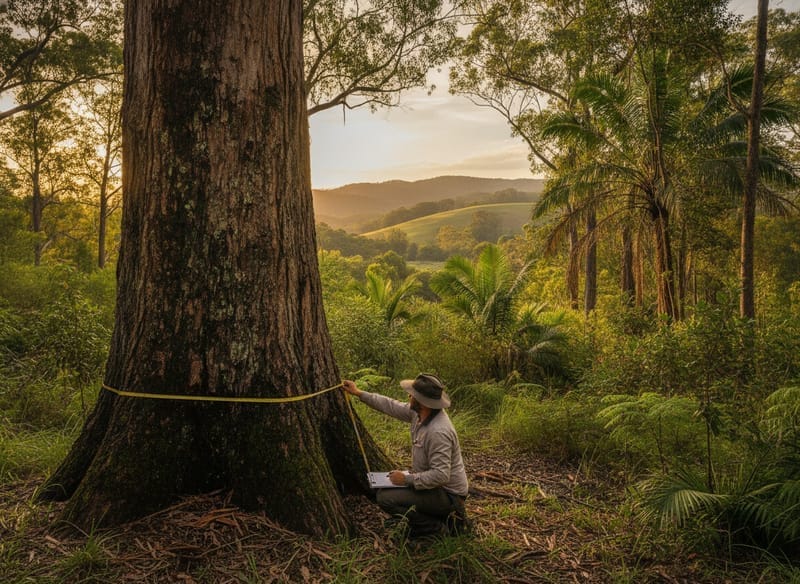
Next, our AQF Level 5 consulting arborist attends your property. During the site visit, we conduct detailed fieldwork. We identify the tree species, measure canopy spread and trunk diameter, evaluate tree vitality, and inspect for structural defects, pests (such as elm leaf beetle), or disease. If it is a development site, we carefully map the necessary Tree Protection Zones against your proposed building footprints.
Following the site visit, we cross-reference our findings with the Tasmanian Planning Scheme - Launceston. We check for relevant overlays like the Landslip Hazard Code or Natural Assets Code to ensure our recommendations align with local regulations.
Finally, we compile all data into a comprehensive, signed PDF report. This document includes photographic evidence, site maps, scientific justifications, and clear next steps, giving you a ready-to-submit package for your builder, architect, or the City of Launceston.
All our consulting work is anchored in strict Australian Standards. Our tree protection plans strictly adhere to AS4970 - Protection of Trees on Development Sites, while any pruning recommendations we prescribe follow AS4373 - Pruning of Amenity Trees, explicitly ruling out damaging practices like lopping or topping.
Our reports are authored exclusively by AQF Level 5 Diploma-qualified arborists, the standard required by local authorities. Furthermore, our business is fully protected with comprehensive Professional Indemnity insurance for all consulting advice, alongside Public Liability and WorkCover insurance for our on-site inspection operations, ensuring total peace of mind while we are on your property.
Unlike some municipalities, Launceston does not have a blanket tree control or a simple trunk-size rule. Instead, the need for an Arborist Report Kings Meadows usually stems from specific overlays within the Tasmanian Planning Scheme.
If your property sits within the Natural Assets Code, the Local Historic Heritage Code, or on steeper terrain governed by the Landslip Hazard Code, any significant tree work or nearby building activity will trigger council scrutiny. We regularly assess the local mix of established exotics, like English elms and silver birches, alongside native eucalypts.
Our local knowledge also factors in Launceston’s specific environmental hazards. We understand how the wet winters soften the soil and how the windy spring weather loads the canopies of newly leafed deciduous trees, leading to seasonal limb drop. We incorporate these localised risks directly into our SULE ratings and hazard assessments.
Once you receive your finalised PDF report, the immediate next step is to submit it alongside your Development Application to the City of Launceston, or hand it to your builder, architect, or insurance provider. If the report specifies a Tree Protection Zone (TPZ), you must ensure compliant fencing is erected before any heavy machinery enters the site. Should your report recommend pruning, hazard reduction, or justified removal, call our team back. Our AQF Level 3 climbing arborists have the equipment and expertise to execute the recommended works safely, exactly as prescribed in the report.
Report costs depend on the number of trees and the complexity of the project.
Call us for an accurate quote tailored to your consulting needs.
Consulting services available in:
Contact our AQF5 arborists today to discuss your project.
Get a Quote