Restored Property Access
Quickly clear driveways, paths, and lawns so your daily life can return to normal.
Professional, comprehensive cleanup of storm-damaged trees, broken limbs, and hazardous canopies.
Providing thorough post-storm recovery in Mowbray and Launceston.
Our Storm Damage Tree Removal Mowbray service is focused on the comprehensive cleanup and restoration of your property after a severe weather event.
When strong spring winds hit Launceston, Mowbray's mature deciduous trees—especially those in full leaf—often suffer tear-outs or limb failure. We specialise in cleaning up this specific type of heavy canopy damage safely.
Quickly clear driveways, paths, and lawns so your daily life can return to normal.
Ensure no hanging branches fall on your family days or weeks after the storm has passed.
We clean up the jagged, torn branches, making your trees and garden look tidy and cared for again.
We assess your Mowbray property to identify the most critical hazards and damaged trees.
We provide a clear quote for the cleanup, which can be submitted to your insurer if applicable.
We safely bring down hung-up branches and dismantle irreparably damaged trees.
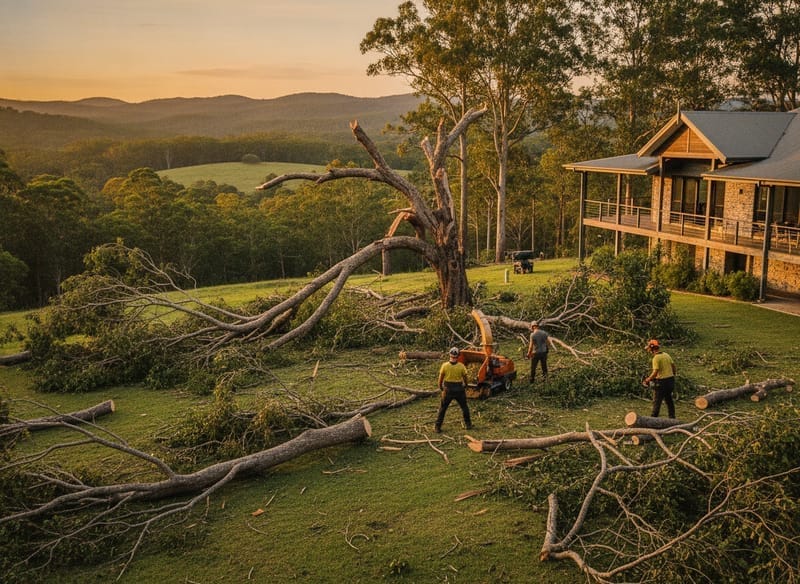
All fallen debris is chipped, and the site is raked clean.
As the senior arborists at Launceston Arborist, we know firsthand the devastation that high winds and saturated soils can inflict on local properties. When wild weather rolls through Northern Tasmania, Storm Damage Tree Removal Mowbray services become critical for homeowners, acreage managers, and developers needing immediate, safe resolutions to severe canopy failures. Mowbray features a beautiful mix of established exotic species like English oak, silver birch, and English elm, alongside native white gums (Eucalyptus viminalis). However, the combination of Launceston’s cool temperate wet winters and the notorious windy stretch from September to January creates a perfect storm for root-plate failures and snapped branches. When these heavily canopied trees carry excess moisture and face gale-force winds, the resulting failures can be catastrophic. Whether a massive limb has crashed through a roof, or a completely uprooted tree is blocking your driveway, you need a highly qualified, local climbing team to respond. We provide rapid triage, make-safe solutions, and complete clearance to secure your property, acting quickly to mitigate further risks to your home and family.
After a severe weather event, the urge to start clearing debris with a shed chainsaw can be overwhelming. However, tackling storm-damaged timber without professional training is incredibly dangerous. Fallen or partially collapsed trees are entirely unpredictable. They often hold immense stored kinetic energy in twisted limbs, compressed trunks, and uprooted root plates. One wrong cut on a tensioned branch can trigger a lethal snapback or cause a suspended canopy to collapse entirely.
Under-qualified operators and DIY attempts frequently worsen the damage to homes, fencing, and powerlines. As qualified arborists, our team approaches every hazardous site with strict adherence to safe work practices. When a tree is severely damaged but still standing, we don't just hack away at the remaining structure. If parts of the tree can be salvaged safely, we follow AS4373 (Pruning of Amenity Trees) to perform targeted reduction and crown thinning.
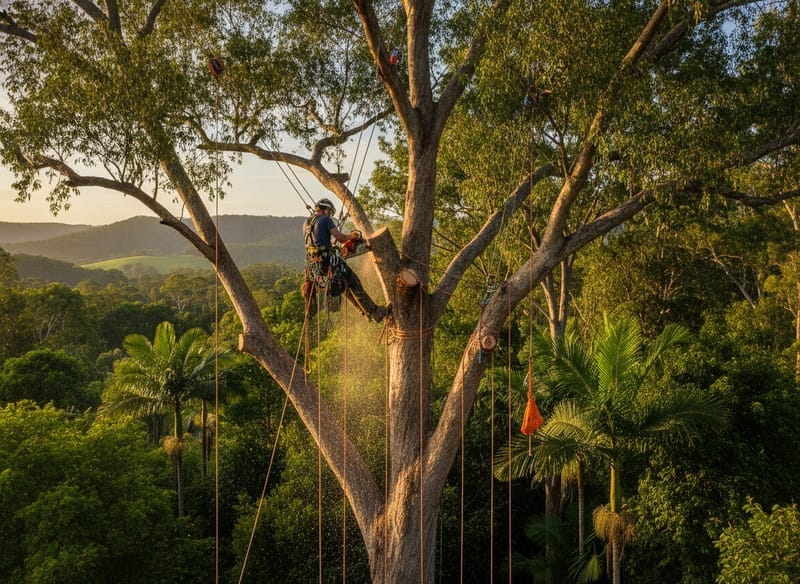
This standard ensures the tree isn't left as an unstable, lopped hazard that will drop weak epicormic growth in the next major gale. Whether it is a shattered silver birch in a tight residential backyard or a massive black peppermint hung up on a boundary fence, we use specialized rigging and elevating work platforms (EWPs) to safely dismantle the hazard piece by piece.
Responding to structural tree failure requires much more than just a chainsaw; it demands systematic hazard assessment, advanced rigging, and specialized heavy machinery. Here is how our AQF Level 3 climbers and machinery operators safely manage complex storm cleanups across local properties.
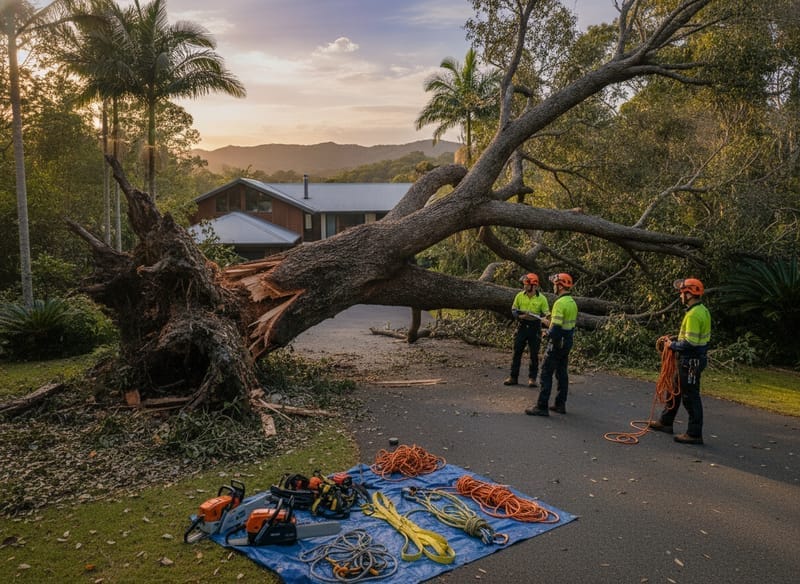
We assess the property to prioritize critical hazards, such as massive limbs suspended over roofs or access paths. Our arborists establish safe exclusion zones and perform urgent relief cuts to stabilize the damaged canopy, preventing secondary property damage.
Storms frequently leave large branches or whole trees lodged in neighboring canopies. We utilize double-rope climbing techniques and specialized friction devices to dismantle the tensioned timber section by section, lowering debris safely to the ground without impact.
Saturated winter soils often cause complete tree failure where the entire root ball lifts. We carefully manage the massive weight shifts during extraction, ensuring the trunk is bucked down safely before the heavy root plate violently snaps back into its cavity.
For large-scale debris, we deploy heavy-duty wood chippers and tipper trucks. We efficiently process branches into mulch on-site and use loader cranes for heavy log extraction, ensuring your property is cleared of all dangerous obstructions.
When severe weather strikes Northern Tasmania, you need a streamlined, predictable process to restore safety to your property. Here is exactly how our team manages your storm recovery from start to finish. 1. Emergency Contact and Dispatch When you call us regarding a downed or dangerous tree, we ask specific questions about your site's access and the immediate risks (such as structural damage to buildings or blocked driveways). This helps us dispatch the right heavy equipment and climbing gear. 2. On-Site Triage and Quotation We arrive promptly to conduct a rapid hazard assessment. We outline a clear plan to make the site safe and provide a detailed, itemised quote. This documentation is structured perfectly for you to hand straight to your insurance company, complete with necessary pre-work photographic evidence. 3. Make-Safe and Rigging Operations Our AQF Level 3 climbers and EWP operators mobilize. We focus first on stabilizing suspended branches and removing weight from compromised structures. Using specialized rigging blocks and ropes, we dismantle hazardous sections without causing further damage to the ground or underlying infrastructure. 4. Processing and Cleanup We do not leave your yard looking like a disaster zone. We use heavy-duty wood chippers to process the canopy into mulch. The large timber is cut to manageable lengths and removed via our tipper trucks, leaving your property safe and accessible.
Safety is our absolute priority during chaotic post-storm conditions. Launceston Arborist is fully public liability insured and strictly covered by WorkCover, protecting you and our staff on every single job. Our climbers hold AQF Level 3 in Arboriculture, ensuring that every chainsaw cut and rigging maneuver is executed by a rigorously trained professional.
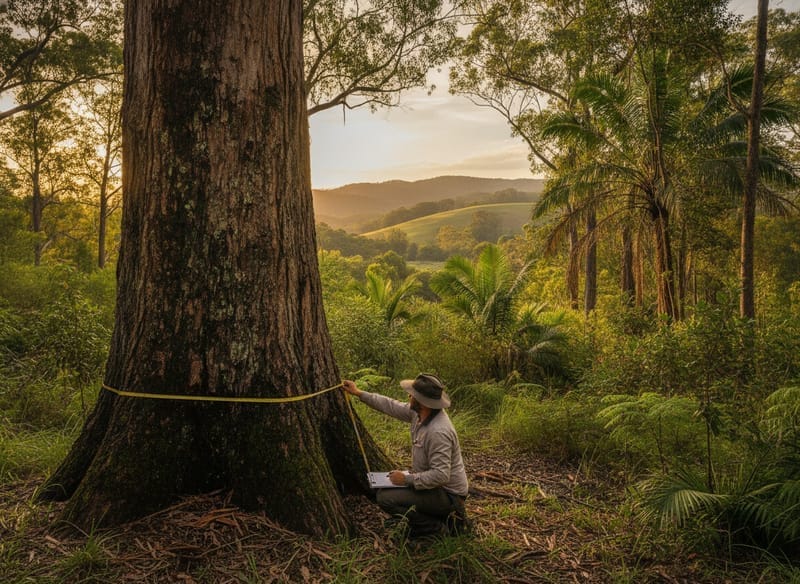
If standing trees require assessment for hidden structural faults post-storm, our AQF Level 5 consulting arborists can provide formal risk assessments for your peace of mind. We complete all remedial pruning and canopy stabilization to AS4373 standards, specifically avoiding detrimental lopping practices that compromise the tree's future stability and lifespan.
Mowbray properties often feature large, mature exotics like oaks and elms, alongside native black peppermints (Eucalyptus amygdalina). During Launceston's high-wind spring days, these heavily canopied trees carry a vast amount of 'sail', making them highly susceptible to sudden limb failure. Under the Tasmanian Planning Scheme - Launceston, there is no blanket municipality-wide tree size rule. However, properties may fall under the Natural Assets Code, Local Historic Heritage Code, or Landslip Hazard Code on steeper blocks. Fortunately, the scheme includes critical state exemptions for emergency works. Work to remove an unacceptable safety risk or a tree damaging a building generally bypasses standard development application delays. When providing Storm Damage Tree Removal Mowbray locals rely on, we understand exactly how the City of Launceston interprets these exemptions. We provide the necessary arborist documentation to prove the tree was a genuine, immediate hazard, keeping you entirely compliant with local planning laws.
Once the immediate hazard is cleared, it is crucial to assess the surviving trees on your property. High winds can cause hidden fractures in remaining limbs that may not fail until weeks after the storm event. We highly recommend booking an inspection for any large trees near your home before the next wind event hits. If you opted to retain the resulting mulch, spread it around your garden beds to help soil moisture retention, keeping it clear of the immediate tree trunks to prevent collar rot. If you notice any hanging branches, sudden leaning, or cracked bark in your remaining canopy, contact our team for a follow-up assessment.
Pricing for storm cleanup in Mowbray depends on the scale of the damage.
We provide transparent, itemised quotes to ensure you and your insurer know exactly what is required.
Delivering fast post-storm cleanup in Mowbray and nearby areas.
Contact our expert team to make your property safe and tidy again.
Get a Free Quote