Council Approval
Provide the necessary documentation to get your development or removal approved.
Formal, AQF Level 5 arborist reports for council applications and hazard assessments.
Providing consulting arborist services in Prospect and Launceston.
If you need an arborist report Prospect council will accept, our consulting arborists deliver accurate, highly detailed documentation.
Whether you are dealing with the Local Historic Heritage Code or Natural Assets Code in Launceston, our reports provide the exact evidence council requires for tree removal or retention.
Provide the necessary documentation to get your development or removal approved.
Identify hazardous trees before they fail with a formal risk assessment.
Know exactly which trees can be removed and which must be protected on your block.
We discuss your project requirements or the specific tree issue.
Our Level 5 arborist visits the Prospect site to assess the trees in detail.
We evaluate the findings against AS4970 and local council codes.
You receive a comprehensive, formal written report ready for submission.
Need a formal assessment for council approval, development, or risk management? Getting an Arborist Report Prospect is the first crucial step for property owners, developers, and managers navigating tree management in our local area. Whether you are dealing with a development application (DA) on a subdivided block or need to document the health of a declining English oak overhanging your home, our team provides comprehensive, independent, and actionable assessments.
We are the local experts. When you book us, our qualified AQF Level 5 consulting arborist visits your site, gathers the data, and authors the documentation you need. We understand that in Prospect and the wider Launceston area, navigating the Tasmanian Planning Scheme can be complex. From risk assessments following a wild spring storm to tree protection plans for a new build, we deliver the definitive reports required by the City of Launceston to keep your project moving.
It is a common trap for homeowners and builders to think a quick verbal opinion or a one-page invoice note from a tree lopper will satisfy the council or your insurance provider. When dealing with significant trees in Prospect, a substandard report usually results in a rejected Development Application, delayed construction, or exposed liability if a hazardous tree fails. DIY assessments or reports written by under-qualified operators lack the legal standing required by the City of Launceston. If your property falls under the Natural Assets Code or you are trying to remove a prominent tree on a steep hillside, the council demands robust, scientifically backed evidence. Without an AQF Level 5 consulting arborist detailing the Safe Useful Life Expectancy (SULE) and structural root zone data, your application is likely to stall. Our team solves this by providing meticulously detailed, AS4970 and AS4373-compliant reports. We conduct thorough Visual Tree Assessments (VTA) to document defects, target zones, and disease indicators like elm leaf beetle. By presenting the facts clearly, we give council planners and developers exactly what they need. We take the guesswork out of the process, ensuring your project remains compliant, safe, and on schedule.
Our consulting arborists utilise industry-standard methodologies to assess, document, and manage tree health and retention. Here is a breakdown of the specialised reporting services we provide.
When building or subdividing, councils often require a comprehensive tree inventory. We identify species, measure the Diameter at Breast Height (DBH), calculate the Safe Useful Life Expectancy (SULE), and outline retention recommendations to satisfy planning requirements.
Essential for construction sites retaining trees. We calculate and map out Tree Protection Zones (TPZ) and Structural Root Zones (SRZ). The report details required physical protections, such as exclusion fencing and root mapping, to ensure trees survive the build process.
We conduct a Visual Tree Assessment (VTA) following QTRA principles to evaluate the likelihood and consequence of tree failure. This documents structural defects, hollows, or decay, which is vital for pre-purchase inspections, schools, strata management, and insurance purposes.
If a protected tree needs to be removed due to declining health or an unacceptable safety risk, we provide the documented evidence required by the council. This includes a detailed condition report, risk analysis, and necessary replanting recommendations.
Getting a detailed arborist report should not be complicated. We manage the process seamlessly from your initial enquiry to the delivery of your finalised PDF document.
First, we start with a consultation. You tell us why you need the report—whether it is for a DA, a hazard assessment of a large silver birch, or a neighbour dispute. We review the site location in Prospect and cross-reference it with the Tasmanian Planning Scheme to understand if any specific overlays, like the Local Historic Heritage Code or Landslip Hazard Code, apply to your block.
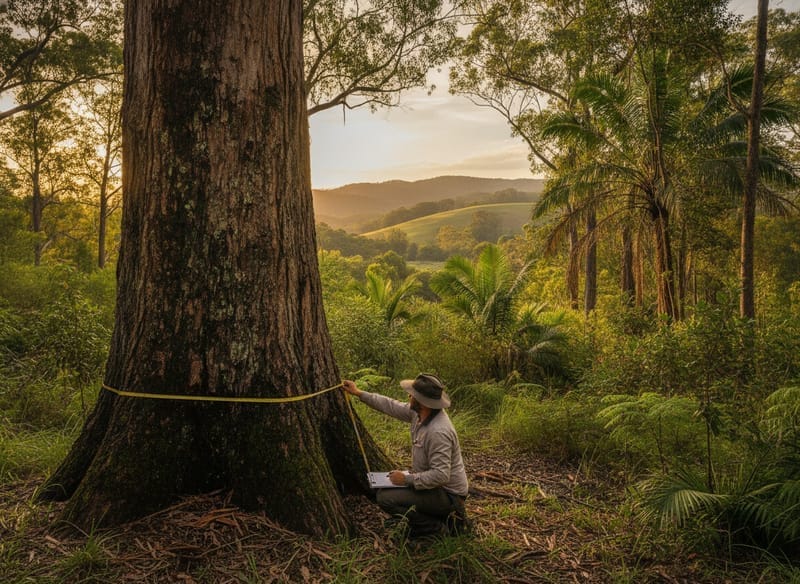
Next, our AQF Level 5 arborist conducts a comprehensive site visit. We physically measure the trees (DBH, canopy spread, height), assess overall vitality, check for structural faults, and take necessary photographic evidence. We map out the location of each tree in relation to existing or proposed structures to calculate accurate protection zones.
Finally, we draft the formal report. We synthesise the field data into a clear, legally sound document that includes risk matrices, AS4970 calculations, and clear recommendations. The final, signed report is delivered to you digitally, ready for submission to the council, your builder, or your insurance provider.
All our reporting and consulting services are delivered by an AQF Level 5 Diploma-qualified consulting arborist, which is the baseline standard required by the City of Launceston for formal documentation. Our development reports strictly adhere to AS4970 (Protection of Trees on Development Sites), ensuring Tree Protection Zones are calculated accurately.
When pruning recommendations are made, they follow AS4373 (Pruning of Amenity Trees), prioritising the structural integrity of the tree. Our business is fully insured with public liability, WorkCover, and professional indemnity insurance, giving you peace of mind that the advice you receive is both legally sound and structurally reliable.
Commissioning an Arborist Report Prospect requires specific local knowledge. While there is no blanket tree control or significant tree register across the municipality, the rules change drastically depending on where your property sits. If you are on a slope, the Landslip Hazard Code may apply, meaning the removal of even standard native vegetation like white gum or silver wattle could require a permit and an arborist sign-off.
Launceston also boasts some of the finest mature exotic canopies in Australia. Managing large English oaks, elms, and poplars on established properties often triggers heritage or scenic protection overlays. Furthermore, our region faces intense spring winds and the ongoing management of elm leaf beetle. Our reports take these unique local climate stressors and council codes into account, providing highly localised, accurate advice that mainland or out-of-town consultants simply cannot match.
An arborist report is only as valuable as the actions you take afterward. If your report includes a Tree Protection Plan for construction, the specified exclusion fencing and mulch must be installed before heavy machinery arrives on site to prevent root compaction.
If the assessment identifies structural pruning or deadwooding to mitigate a hazard, our AQF Level 3 climbing arborists can execute the prescribed works strictly to AS4373 standards. For retained trees on development sites, we recommend scheduling a follow-up inspection post-construction to ensure no hidden root damage has compromised the tree's health. Give our team a call when you are ready to action your report's recommendations.
Arborist reports are priced based on the complexity of the site and the number of trees.
We provide a fixed-price quote for all arborist reports prior to the site visit.
Consulting arborist services available in:
Contact our AQF Level 5 arborists today to discuss your reporting requirements.
Request a Report Quote