Build-Ready Site
Clear vegetation so your builders or fencers can start work.
Efficient, large-scale vegetation removal for developments and property maintenance.
Providing land clearing in Prospect, St Leonards, Relbia, and Launceston.
For comprehensive land clearing Prospect property owners rely on, we provide scalable solutions for blocks of all sizes.
Whether you are preparing a residential block in Prospect or managing paddock eucalypts on the rural-residential fringe, we navigate local codes to clear your land legally and efficiently.
Clear vegetation so your builders or fencers can start work.
Reduce fuel loads to protect your property during the summer fire season.
Turn overgrown scrub into accessible, usable land.
We walk the block with you to understand the boundaries and goals.
We identify any trees protected by the Natural Assets Code or other overlays.
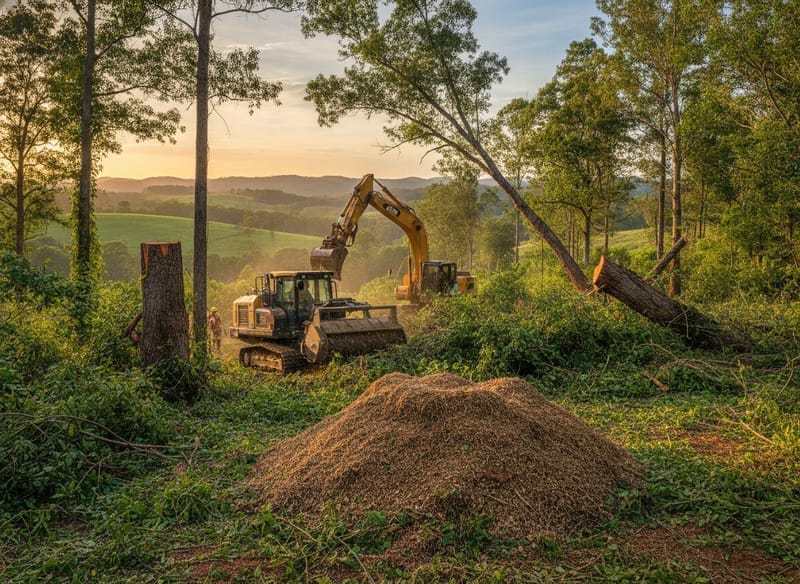
Our machinery moves in to fell trees and clear scrub safely.
Vegetation is mulched on-site or hauled away, depending on your preference.
If you are preparing a residential block for a new build, extending a paddock, or managing bushfire risks on your acreage, securing professional Land Clearing Prospect is the crucial first step. Whether you are dealing with a flat, wet block or a sloping dolerite hillside, clearing vegetation safely and legally requires heavily specialised arboricultural expertise.
Prospect and the surrounding Launceston suburbs, including Relbia and Newstead, feature a mix of established exotic gardens and native dry sclerophyll fringes. This unique blend means a site preparation job could involve anything from selectively removing dense understory scrub to carefully dismantling large, senescent trees while retaining valuable canopy.
We are Launceston's local arborist team. Our climbers, machine operators, and heavy trucks are equipped to handle block clearing of any scale. We focus on delivering a clean, builder-ready site while strictly preserving the trees you wish to keep, ensuring your property is prepared safely, efficiently, and in full compliance with local Tasmanian regulations.
A common mistake property owners make is hiring earthmoving contractors to bulldoze a site indiscriminately, treating vegetation simply as debris. This heavy-handed approach regularly leads to compacted dolerite soils, severe damage to the Structural Root Zones (SRZ) of trees you intended to keep, and costly breaches of the Launceston Local Provisions Schedule.
When excavators tear through root systems, retained trees become highly susceptible to wind-throw during our famously windy spring and early summer months. Furthermore, clearing without assessing the site for mapped priority vegetation or heritage overlays can result in significant council fines and project delays. Unqualified operators frequently use poor pruning techniques to clear access paths, leaving large stubs that promote decay and ruin the amenity value of mature trees.
Our team provides a precise, arborist-led solution. Rather than blindly pushing scrub over, we selectively fell and process vegetation. We identify Tree Protection Zones (TPZ) in accordance with AS4970 — Protection of Trees on Development Sites, ensuring the white gums (Eucalyptus viminalis) or English oaks you want to keep remain healthy and structurally sound. By processing the cleared timber through our high-capacity chippers on-site, we leave your property clean, protected, and perfectly prepped for the next stage of your project.
Effective land clearing requires a strategic blend of heavy machinery operation, precision felling, and deep arboricultural knowledge. Our team uses specialised equipment and proven methodologies to clear your site efficiently while protecting the surrounding Launceston environment.
We identify and physically tag retained vegetation before work begins. Our operators then selectively fell the required trees and scrub, strictly enforcing Tree Protection Zones (TPZ) for retained canopy to prevent soil compaction and root damage from heavy machinery.
For properties near the bush edge requiring a specific BAL rating under AS3959, we strategically clear ladder fuels, deadwood, and understory scrub. This establishes a compliant Asset Protection Zone (APZ) while preserving the core ecological and aesthetic value of your acreage.
We clear dense thickets of silver wattle (Acacia dealbata), drooping sheoak (Allocasuarina verticillata), and invasive scrub to create clear boundaries for new fencing, driveway access, or paddock extensions. Where retained trees overhang these new clearings, we perform crown lifting strictly to AS4373 standards.
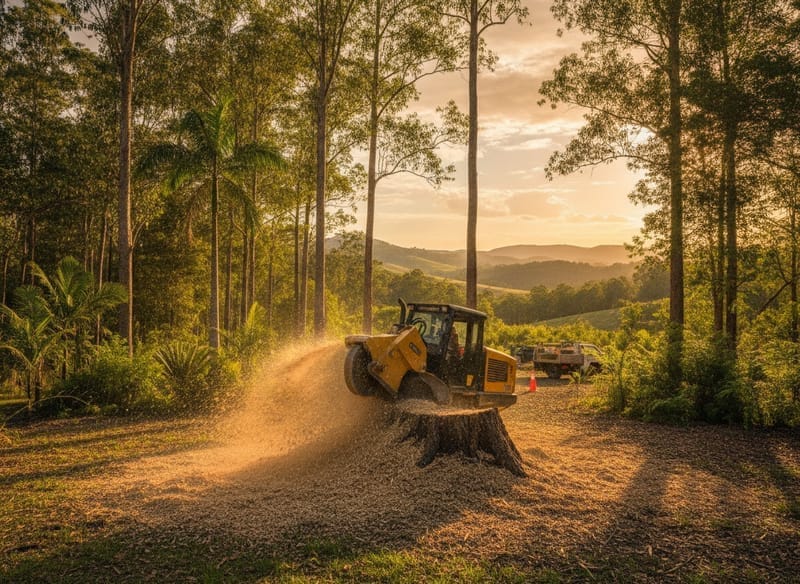
Using high-capacity 12-inch wood chippers and mini-loaders, we process all cleared vegetation into valuable mulch. We also offer comprehensive stump grinding, taking stumps 150–300mm below grade so builders or landscapers can commence work without subterranean obstructions.
Our land clearing process begins with a comprehensive site assessment. When you contact us for a quote, we do more than just look at the trees. We evaluate the terrain, assess access points for our tipper trucks and machinery, and identify any potential environmental overlays or heritage constraints specific to your property in Prospect.
Once the scope is agreed upon and any necessary council or forestry approvals are in place, our AQF-qualified team mobilises to your site. We start by physically marking exclusion zones around retained vegetation. This guarantees that our machinery movements will not encroach on the critical root structures of the trees staying on your block.
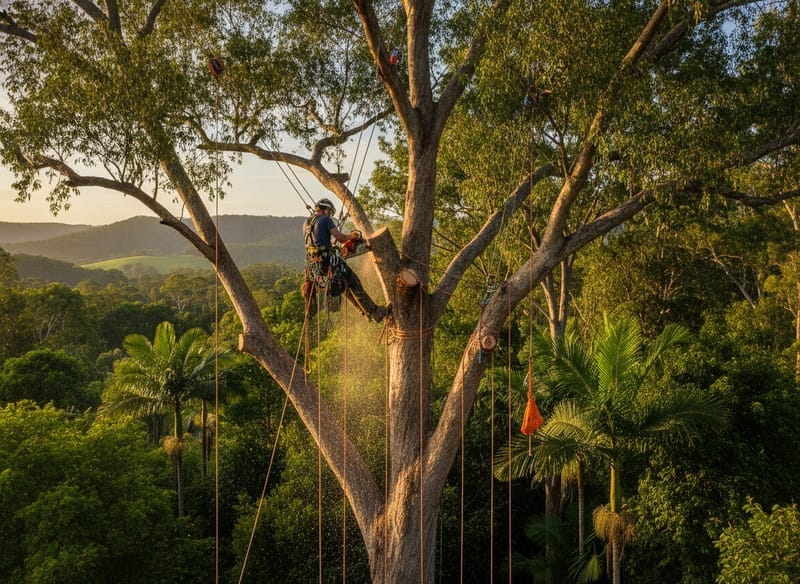
We then conduct the clearing systematically. Smaller scrub and understory are processed first to open up the site. Larger trees designated for removal are either directionally felled or, if close to boundaries, carefully dismantled by our rope-access climbers. For retained trees requiring access clearance, we undertake target pruning in strict accordance with AS4373 — Pruning of Amenity Trees, completely avoiding damaging lopping practices.
Finally, we process the green waste. Branches and scrub are chipped on-site, and heavier logs are either retained for your use or removed via our loader cranes. We finish with stump grinding, leaving you with a clean, level, and highly accessible site.
Land clearing involves heavy machinery, chainsaws, and falling timber, making rigorous safety and compliance non-negotiable. Our business is fully insured with comprehensive Public Liability and WorkCover, giving you total peace of mind while we are on your property.
Our on-site operators hold AQF Level 3 in Arboriculture and all required tickets for chainsaw operation, felling, and first aid. When clearing sites for development, we operate in strict alignment with AS4970 — Protection of Trees on Development Sites, ensuring retained trees are legally and practically safeguarded. If your project requires formal documentation, we can coordinate with AQF Level 5 consulting arborists to provide the necessary reports.
Unlike some municipalities, Launceston does not impose a blanket tree control based on trunk size or height. However, before commencing Land Clearing Prospect projects, we must navigate the Tasmanian Planning Scheme - Launceston.
Whether you need a permit depends heavily on your property's specific zoning and overlays. We routinely check for the Natural Assets Code, which protects mapped priority vegetation, and the Landslip Hazard Code, which is critical on the steeper dolerite hillsides near Trevallyn and West Launceston. For heritage properties, the Local Historic Heritage Code may restrict the removal of mature exotic species like English elm or ash.
Furthermore, for rural-residential acreage in Prospect or Relbia, large-scale clearing operations may trigger the Forest Practices Act 1985 if the clearing exceeds one hectare or 100 tonnes of timber. We guide our clients through these local nuances, ensuring every white gum and black peppermint removed is done so legally and transparently.
Once your land clearing is complete, proper site management is essential, especially given Launceston's wet winters. We highly recommend spreading the generated mulch over exposed soil to prevent erosion and suppress weed regrowth until construction or landscaping begins. It is also critical to monitor any retained trees. Trees that previously grew in dense stands may now be exposed to new wind loads during spring gales. Keep an eye out for signs of soil heaving at the base or sudden branch drop. If you notice structural changes in your retained canopy, call our team for a follow-up assessment.
Land clearing is quoted based on the size of the block and density of vegetation.
We provide detailed, fixed-price quotes for all land clearing projects in Prospect.
Clearing blocks across the wider region.
Prepare your block safely and efficiently with our expert team.
Get a Free Quote