Council Compliance
Ensure your development application meets all local planning scheme requirements the first time.
Comprehensive, independent tree assessments by AQF Level 5 Arborists for development applications, hazard evaluations, and council compliance.
Providing consulting arborist services throughout Punchbowl and Launceston.
Our Arborist Report Punchbowl services provide the essential documentation needed for planning, building, or dispute resolution.
If you are subdividing or building in Punchbowl, the City of Launceston will likely require a report detailing how nearby mature trees—especially those under heritage or vegetation codes—will be protected during construction.
Ensure your development application meets all local planning scheme requirements the first time.
Make informed choices about large trees on your property based on scientific risk assessments.
Professional, easy-to-read reports prevent back-and-forth delays with council planners.
We discuss why you need the report (e.g., DA, safety concern, or council request).
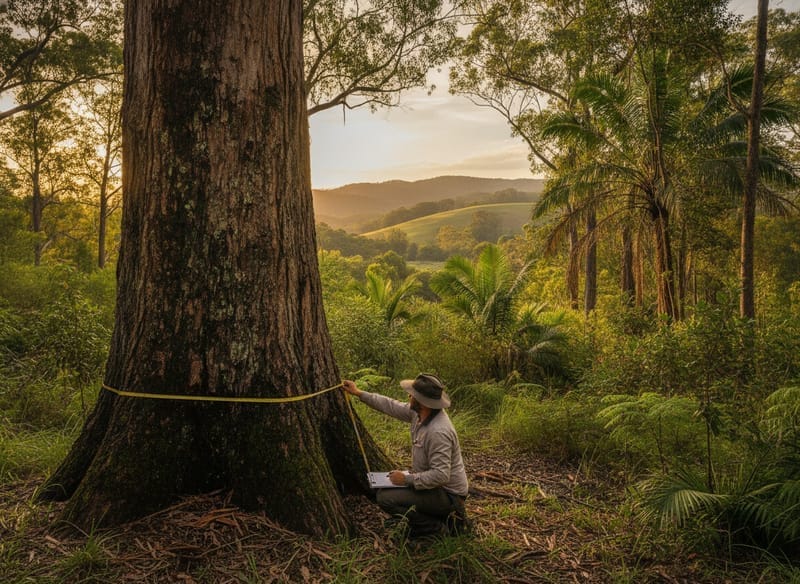
Our AQF Level 5 Arborist visits your Punchbowl property to collect data, measure DBH, and assess tree health.
We compile the data against AS4970 guidelines and local planning codes.
You receive a comprehensive PDF report ready to submit to the City of Launceston or your insurer.
When managing mature trees on your property, securing an accurate and compliant Arborist Report Punchbowl is an essential step. Whether you are a homeowner preparing for a renovation, a developer subdividing an acreage, or a property manager dealing with hazard trees, a formal assessment provides the foundation for safe, legal tree management. In Launceston's unique environment, where established exotic canopies meet steep dolerite hillsides, having a deep understanding of local conditions is critical.
Our team at Launceston Arborist specialises in delivering high-quality, council-ready documentation. As AQF Level 5 consulting arborists, we possess the advanced qualifications required by the City of Launceston to assess, document, and recommend actions for your trees. We do not just look at a tree in isolation; we consider the entire site context, from soil stability to local environmental overlays.
Navigating the Tasmanian Planning Scheme - Launceston can be complex, as tree removal permits are dictated by specific overlays rather than a blanket municipality-wide size rule. We leverage our extensive local knowledge to write reports that clearly address these specific codes, smoothing the path for your development applications and ensuring you meet all legal and safety obligations.
One of the most common pitfalls we see is property owners attempting to submit development applications or tree removal requests using generic letters from under-qualified tradespeople. The local council will strictly reject reports that are not authored by an AQF Level 5 consulting arborist. This rejection leads to stalled building projects, prolonged neighbour disputes, and entirely avoidable holding costs.
Furthermore, DIY risk assessments often result in the unnecessary removal of healthy trees or, conversely, the retention of structural hazards that threaten your home during Launceston's windy spring season. Without a formal Visual Tree Assessment (VTA) and an understanding of structural defects, property owners expose themselves to significant liability if a limb fails.
Our solution is a rigorous, AS4970 and AS4373 compliant approach to tree reporting. We step in to provide independent, scientifically backed assessments that council planners and insurance companies trust. By accurately identifying species, calculating Structural Root Zones (SRZ), and determining Safe Useful Life Expectancy (SULE), our team ensures that your project moves forward without regulatory hiccups. We provide clear, actionable recommendations that balance your property goals with the long-term health of Launceston's urban canopy.
When you engage our team for an Arborist Report Punchbowl, we apply rigorous, industry-standard methodologies. As AQF Level 5 consulting arborists, we deliver comprehensive, meticulously researched documentation tailored to the exact requirements of your site and project.
Required by council when construction occurs near protected trees. We conduct a comprehensive tree inventory, mapping species, measuring Diameter at Breast Height (DBH), and assigning a SULE rating. We then outline strict retention recommendations to support your planning submission.
We design rigorous protection strategies for retained trees during construction. This includes calculating Tree Protection Zones (TPZ) and Structural Root Zones (SRZ), and specifying the placement of exclusion fencing, root mapping, and protective mulch layers to prevent soil compaction.
Utilising Visual Tree Assessment (VTA) and QTRA principles, we evaluate mature trees for structural defects, disease, and decay. Our reports document potential target zones and calculate the likelihood and consequence of failure, providing crucial liability protection for homeowners and schools.
When a tree falls under a local overlay such as the Scenic Protection Code or Landslip Hazard Code, council requires strong justification for its removal. We document the tree's deteriorating condition, unacceptable safety risks, and provide replanting recommendations to secure council approval.
Our consulting process begins with a detailed initial discussion to understand your specific needs—whether you are dealing with a pre-purchase inspection in Punchbowl, a subdivision in Kings Meadows, or a hazard assessment for a mature English oak. We then schedule a prompt on-site visit to conduct the physical assessment. During the site visit, our AQF Level 5 arborist collects comprehensive data. We accurately identify the tree species (such as *Eucalyptus viminalis* or silver birch), measure the trunk diameter and canopy spread, and perform a Visual Tree Assessment to check for basal decay, epicormic growth, and structural faults. We also map the tree's location relative to existing and proposed infrastructure. Next, we conduct a thorough desktop review against the Tasmanian Planning Scheme - Launceston. We cross-reference your property against critical mapping tools to check for the Local Historic Heritage Code, Natural Assets Code, or Landslip Hazard Code. This ensures every regulatory requirement is addressed in our findings. Finally, we compile this data into a formal, highly detailed PDF report. The document includes high-quality site photography, detailed site maps, TPZ calculations, and our expert recommendations. We deliver this signed document directly to you, ready for immediate submission to the local council or your insurance provider.
Creating an authoritative tree report requires strict adherence to Australian Standards. Our AQF Level 5 consulting arborists draft all Tree Protection Plans in direct accordance with AS4970 - Protection of Trees on Development Sites, ensuring your construction project meets all municipal retention requirements.
When pruning or remediation is recommended, our guidelines strictly follow AS4373 - Pruning of Amenity Trees, explicitly advising against detrimental practices like lopping or topping. For properties situated on the bush edge, we factor in AS3959 - Construction of Buildings in Bushfire-Prone Areas. Furthermore, our consulting services are fully backed by Professional Indemnity and Public Liability insurance, giving you total peace of mind when relying on our expert assessments.
Punchbowl features a unique mix of established exotic gardens and native remnants, sitting on terrain that ranges from gentle suburban blocks to steeper dolerite slopes. Because the City of Launceston does not enforce a blanket trunk-size or height rule across the municipality, determining whether you need a permit to remove a tree depends entirely on the zoning and overlays attached to your specific address.
Our local expertise means we know exactly what council planners are looking for. We regularly assess large *Eucalyptus amygdalina* (black peppermint) and mature exotics like English elms and silver birch. We are acutely aware of regional threats, such as the ongoing surveillance for elm leaf beetle, and local hazard drivers, including the fierce spring winds that commonly cause limb drop in heavily canopied trees.
Whether your property falls under the Natural Assets Code or is subject to the Landslip Hazard Code on a steeper block, our reports are tailored to address these specific Tasmanian planning instruments. We ensure your submission aligns perfectly with local expectations, preventing costly administrative delays.
Once we deliver your finalized report, the next step is usually submitting it to the local council alongside your Development Application or tree works request. If your project is approved with retention conditions, you must implement the outlined Tree Protection Zones (TPZ)—such as installing exclusion fencing—before any machinery enters the site. If the report identifies a hazard tree requiring removal or deadwooding, you can directly engage our AQF Level 3 climbing arborists to execute the physical work safely and strictly to AS4373 standards. For retained mature trees, particularly large exotics exposed to Launceston's spring winds, we recommend scheduling an annual visual reinspection to monitor for any newly developing structural defects or signs of disease.
The cost of an arborist report depends heavily on the scope and purpose.
Call us to discuss your requirements, and we will provide a firm, upfront quote for the report.
We provide consulting arborist services for:
Contact our AQF Level 5 consulting arborist to discuss your project.
Request a Quote