Faster Council Approvals
Submitting correct, professional documentation speeds up your Development Application process.
Formal, comprehensive tree assessments by AQF Level 5 consulting arborists for development, risk, and council compliance.
Providing consulting arborist services for Waverley and the City of Launceston.
We provide a range of arborist report Waverley services tailored to homeowners, developers, and project managers.
Waverley's mix of established exotic gardens and steep blocks means developments often trigger council overlays. A solid arborist report is the key to navigating these hurdles smoothly.
Submitting correct, professional documentation speeds up your Development Application process.
Have formal proof of a tree's hazardous condition to protect yourself from liability.
Know exactly what you can and cannot do with the vegetation on your block before you spend money on architects.
We discuss your specific needs, whether it is for a DA, safety concern, or council compliance.
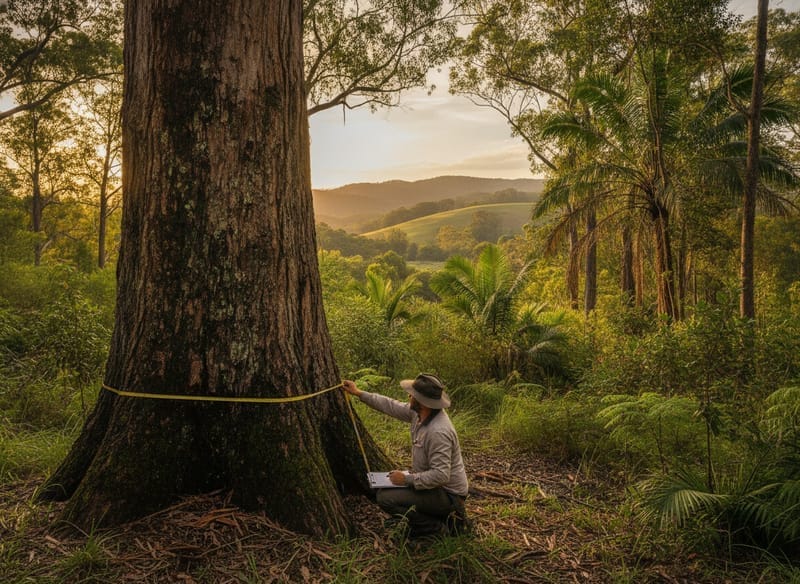
Our consulting arborist visits your Waverley property to measure, photograph, and assess the subject trees.
We calculate Tree Protection Zones (TPZ) and Structural Root Zones (SRZ) as per Australian Standards.
You receive a comprehensive, professionally formatted PDF report ready for council submission.
If you are planning a residential build, managing a large acreage property, or navigating complex council requirements, securing an accurate Arborist Report Waverley is often the crucial first step. At Launceston Arborist, we provide comprehensive, AQF Level 5 consulting services for homeowners, developers, and property managers throughout Waverley and the wider Launceston region.
Northern Tasmania boasts some of the most beautiful established canopies in the country, but managing these trees alongside property development requires expert insight. Whether you need to submit a development application, assess a declining white gum on your boundary, or resolve a complex vegetation dispute with a neighbour, a certified assessment is essential. Our local arborists deeply understand the specific climatic environment of the region, from the wet floodplain soils to the steep, rocky dolerite hillsides.
We know exactly what the City of Launceston requires, and we deliver rigorous, scientifically backed reports that save you time, money, and administrative stress. From established historic gardens in Waverley to rural-residential blocks in St Leonards, our team is equipped to handle everything from single-tree risk assessments to large-scale subdivision vegetation management plans. We are the arborists who do the heavy lifting, ensuring your property plans progress smoothly and safely while preserving the amenity of our local landscape.
A common and costly mistake property owners make is relying on a standard tree lopper, landscaper, or unqualified tradesperson to assess their trees. When dealing with the City of Launceston, a report missing a certified AQF Level 5 sign-off is almost guaranteed to be rejected. This causes significant delays to your development application, forcing you to pay for a second, compliant report and pushing your construction timeline back by weeks or even months. Time is money in property development, and generic advice simply does not cut it.
Beyond council rejection, an inaccurate assessment carries severe physical and financial risks. Launceston experiences a highly active, windy spring to early summer season. Misdiagnosing structural decay, root rot, or weak branch unions in a massive English oak, silver wattle, or black peppermint can lead to catastrophic limb failure over homes, driveways, or public infrastructure. Conversely, unqualified operators often recommend unnecessary removals out of an abundance of caution, costing you valuable mature shade and potentially triggering council penalties if the vegetation was protected by an overlay.
Our certified arboricultural approach eliminates these issues entirely. We utilise industry-standard Visual Tree Assessment (VTA) methodologies and strict adherence to AS4970 standards for development sites. This means you receive exact Tree Protection Zones (TPZ), clear retention values, and irrefutable, science-based recommendations. We provide the hard data needed to stand up to council scrutiny, protect your property from hidden hazards, and ensure you are not clearing vegetation illegally.
As AQF Level 5 consulting arborists, we deliver a full suite of reporting services tailored to Launceston properties and specific council requirements.
Required by the local council when a DA proposes works near or the removal of protected vegetation. We provide a comprehensive tree inventory, precise species identification, exact DBH (Diameter at Breast Height) measurements, and SULE (Safe Useful Life Expectancy) ratings. This provides council planners with a clear understanding of the site's biological assets.
Essential for any building work occurring near retained trees. We calculate precise Tree Protection Zones (TPZ) and Structural Root Zones (SRZ). This documentation includes mapping out temporary fencing, ground mulch protection, and supervised work zones to ensure heavy machinery and trenching do not compromise essential root systems.
Utilising internationally recognised VTA principles, we assess hidden and visible hazards on mature canopies. We document structural defects, cavity depth, canopy decline, and target zones, thoroughly evaluating the likelihood and consequence of failure for high-risk species during Launceston's notoriously windy spring season.
When a tree falls under a specific overlay or council code, we document its exact condition, structural integrity, and the biological justification for its removal. This provides the necessary evidence for exemptions or permit approvals, often accompanied by tailored replanting recommendations.
In the event of storm damage, property impact, or boundary disputes, we provide independent, factual reporting. Our causation analysis and damage assessments are highly detailed, offering expert-level documentation suitable for insurance claims or legal proceedings.
Delivering a precise, actionable arborist report requires a systematic, transparent approach. When you engage our team for an assessment in Waverley, we follow a rigorous, step-by-step methodology to ensure every detail is captured for your council submission, architect, or peace of mind. First, we conduct a detailed initial consultation to understand the exact scope of your project. Whether it is a pre-purchase inspection, a complex DA submission requiring root mapping, or a hazard concern regarding an aging eucalyptus overhanging a roof, we clarify the objectives upfront. Next, our AQF Level 5 consulting arborist arrives on-site to conduct the physical field assessment. We utilise professional equipment, including DBH tapes and laser rangefinders, to measure trunk diameter and canopy spread. We evaluate the overall tree health, photograph structural defects, and carefully identify the species, noting specific local varieties like Eucalyptus amygdalina or heritage elms. Once the field data is comprehensively collected, we cross-reference our findings back at the office with the Tasmanian Planning Scheme and specific Launceston codes, such as the Natural Assets Code. We model the necessary setbacks and root zones. Finally, we compile all data, calculations, site maps, and photographic evidence into a comprehensive, professionally formatted PDF report. This document is fully signed off and delivered to you, ready for immediate submission to the council.
Writing an authoritative arborist report requires strict adherence to national guidelines and local legislation. Our consulting arborists hold AQF Level 5 (Diploma of Arboriculture) qualifications, which is the mandatory professional standard required by the City of Launceston for formal documentation and DA sign-offs.
All our consulting practices are strictly governed by AS4970 Protection of Trees on Development Sites and AS4373 Pruning of Amenity Trees. This ensures our recommendations for root zone protection and canopy management are legally, biologically, and structurally sound. We never rely on guesswork. Furthermore, our business is fully public liability and professional indemnity insured. This dual coverage gives you complete peace of mind when we provide technical, high-stakes advice on tree retention, complex development applications, and hazard mitigation across Waverley.
Securing an Arborist Report Waverley often involves navigating the specific nuances of the Tasmanian Planning Scheme as it currently applies to the City of Launceston. Unlike some municipalities, Launceston does not operate under a blanket municipality-wide trunk size rule or a simple significant tree register. Instead, vegetation protection depends heavily on location-based codes and overlays.
Properties in Waverley, as well as nearby suburbs like Trevallyn or Newstead, may trigger the Natural Assets Code (covering priority vegetation) or the Local Historic Heritage Code. For steeper blocks in the region, the Landslip Hazard Code is a major consideration, as removing mature tree roots can drastically destabilise the dolerite hillsides. We also actively monitor for local biosecurity issues such as elm leaf beetle pressure in established exotic canopies. Our reports specifically address these local overlays, providing the exact terminology, species data, and structural root zone calculations the local planning department expects to see, ensuring your application moves forward without unnecessary bureaucratic friction.
Once you have received your final report, the immediate next step is submitting the PDF to the City of Launceston alongside your Development Application or tree removal permit request. If the report outlines specific tree protection measures for an upcoming build, these must be implemented—such as installing AS4970-compliant exclusion fencing and signage—before any site works or heavy machinery arrive. Should your report recommend canopy reduction, selective deadwooding, or complete removal to mitigate a hazard, our in-house AQF Level 3 climbing arborists can execute the physical tree work in strict accordance with AS4373 standards. We also strongly recommend scheduling a follow-up assessment for retained mature trees every two to three years, or following severe Launceston spring storms, to ensure their ongoing safety and structural integrity.
The cost of an arborist report depends on its purpose and the number of trees assessed.
We provide an upfront, fixed-price quote for all consulting and reporting work.
Our consulting arborists operate across Waverley and all Launceston council jurisdictions.
Contact our AQF Level 5 consulting arborists today to discuss your requirements in Waverley.
Book a Consultation