Restore Your Yard
Get your property looking neat and tidy again quickly.
Efficient, safe cleanup of fallen limbs, broken canopies, and storm-wrecked trees.
Serving West Launceston and greater Launceston after major weather events.
Our Storm Damage Tree Removal West Launceston team handles everything from single snapped branches to total block cleanups.
Launceston's windy spring season routinely strips heavily-leafed exotic trees in West Launceston and Trevallyn. We are highly experienced in cleaning up oak, elm, and poplar storm damage.
Get your property looking neat and tidy again quickly.
We remove compromised branches before the next gust of wind brings them down.
We do all the heavy lifting and disposal, saving you days of back-breaking work.
We inspect your property and identify the most critical hazards.
We provide a clear price and take photos for your insurance.
Our team cuts up fallen timber and chips the smaller branches.
We check the remaining standing trees to ensure they are safe.
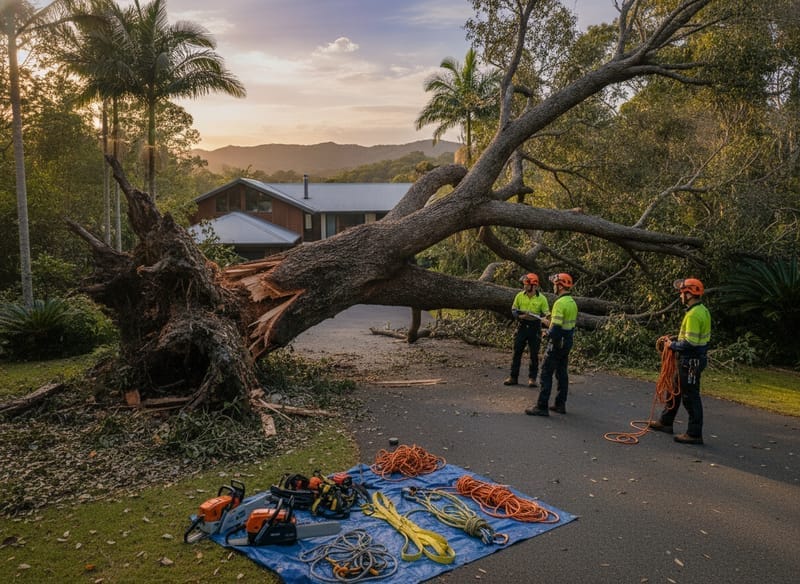
When severe spring and early summer winds sweep up the Tamar estuary, heavy canopies can fail without warning, putting homes and property at immediate risk. If you are facing fallen timber, hung-up branches, or uprooted trunks, prompt Storm Damage Tree Removal West Launceston is essential to secure your property and ensure your family's safety. Our team at Launceston Arborist provides rapid, highly skilled emergency response across the gorge-side blocks and steep dolerite hillsides of West Launceston, Trevallyn, and surrounding suburbs. Our cool temperate climate brings wet winters that saturate the soil, followed by strong seasonal winds that catch the heavy leaf canopies of both native white gums and the large exotic elms and oaks lining our historic streets. This combination often leads to sudden root-plate failures and snapped limbs that crash onto roofs, block narrow access roads, or pull down powerlines. We bring the heavy equipment, technical climbing skills, and local knowledge required to safely dismantle hazardous trees in tight, challenging terrain.
Attempting DIY removal of storm-damaged timber is incredibly dangerous and often leads to severe secondary property damage or serious injury. Trees that have snapped, twisted, or partially uprooted are heavily loaded with unpredictable tension and compression forces. One wrong chainsaw cut can cause a massive log to roll, snap back, or crush whatever is beneath it.
Beyond the physical danger, unskilled contractors or DIY attempts often fail to properly assess the structural integrity of the remaining tree. When part of a canopy is torn away, the surviving branches are left exposed to wind shear they were never adapted to handle. Poorly executed 'lopping' or flush-cutting of damaged limbs introduces decay and guarantees the tree will become a larger hazard down the track.
Our qualified AQF Level 3 climbing arborists take a systematic, safety-first approach. We understand how to read tension in fallen timber and safely winch heavy trunks away from your home. Where parts of a tree are salvageable, we apply AS4373-compliant pruning techniques to remove the fractured limbs, balance the remaining crown, and give the tree the best chance of survival. We protect your property while cleanly removing the hazard.
Handling storm-damaged trees on the steep, tightly packed blocks of our local hillsides requires advanced arboricultural techniques. We utilise specialised equipment and strategic planning to resolve complex failures safely.
We walk the property to categorise hazards. Immediate risks, such as large limbs resting on roofs or blocking primary access, are secured first. We use temporary rope systems to stabilise hung-up branches before safely lowering them to the ground, preventing further impact to your building.
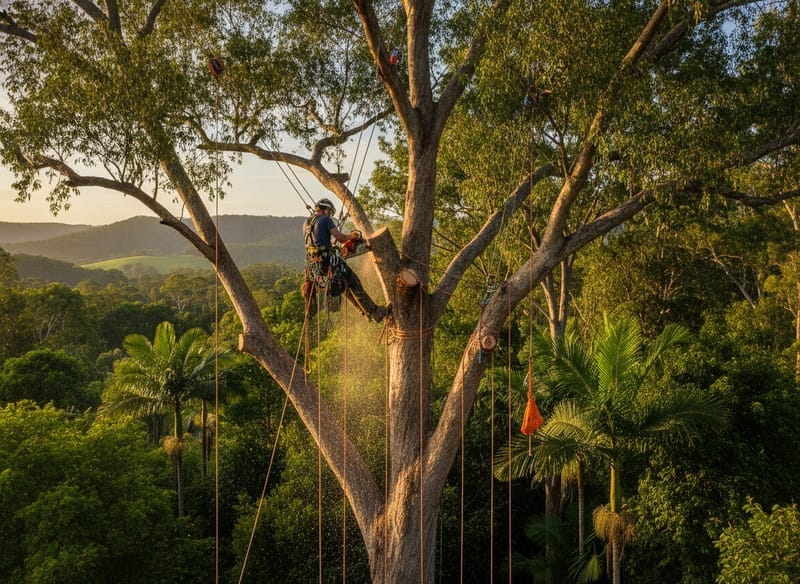
Because West Launceston is characterised by steep gorge blocks and narrow winding streets, elevating work platforms (EWPs) often cannot reach the hazard. Our arborists utilise advanced single-rope and double-rope access techniques to climb the safe remaining structures or adjacent trees, carefully rigging and lowering shattered limbs section by section.
Winter rains can saturate Launceston's soils, leading to whole-tree uprooting where the tree leans heavily but remains partially anchored. We employ heavy winches, mechanical advantage pulley systems, and ground saws (like the MS500i) to meticulously sever the tensioned wood, safely settling the root ball back into the cavity while dismantling the trunk.
Storm damage requires clear, itemised evidence for smooth insurance claims. Before cutting begins, we take comprehensive photographs of the damage, the impact on structures, and the required make-safe works. We provide detailed, line-by-line quotes that you can submit directly to your insurer.
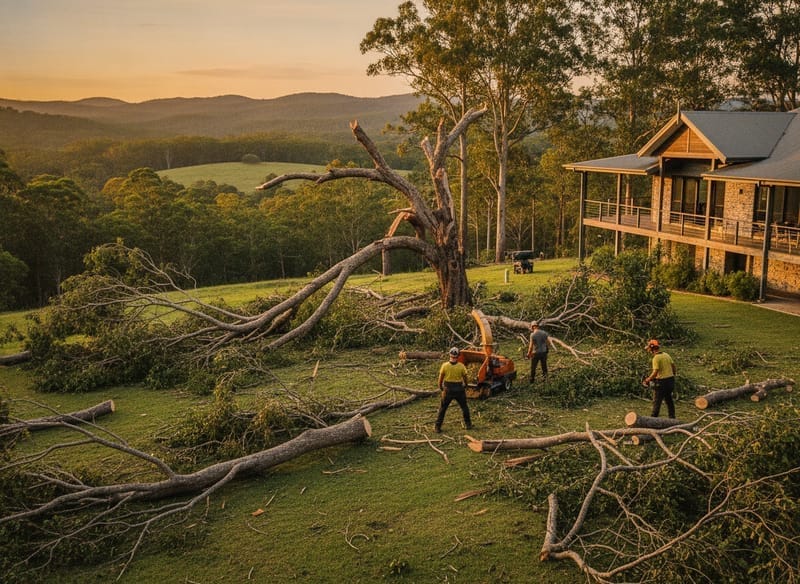
Once the hazards are neutralised, our team processes the timber on-site. We feed branches through high-capacity chippers to create useful mulch, while heavier logs from large exotic oaks, elms, or native black peppermints are loaded onto our tipper trucks using loader cranes for complete site clearance.
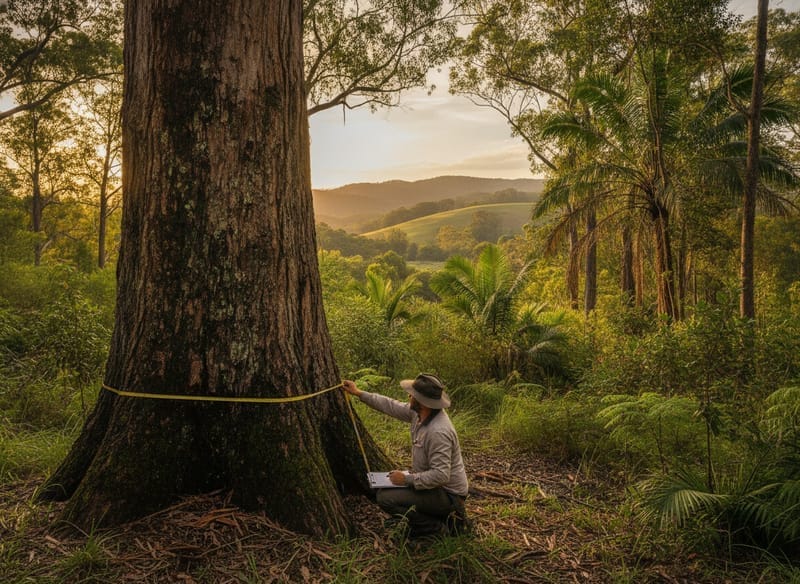
When you contact us for emergency tree work, our process is designed to mitigate risk while keeping you informed every step of the way. First, we conduct a rapid site triage. Our consulting arborist will assess the structural stability of the damaged trees, identifying which branches are hung up, which root systems have lifted, and where the immediate danger lies. We outline the necessary make-safe works and capture all required photographic evidence for your insurance company. Next, our crew executes the make-safe operation. This focuses entirely on removing the immediate threat to life, dwellings, and infrastructure. Using advanced rope access or tracked spider lifts where terrain permits, we carefully rig and lower the critical hazards. Throughout this phase, our traffic management trained staff ensure that operations on narrow West Launceston hillside streets remain safe for the public. Finally, we return to complete the full Storm Damage Tree Removal West Launceston cleanup. We safely dismantle the remaining compromised timber, chip the canopy debris, block down the trunk, and rake the site clean. If replanting is desired, we can provide advice on suitable replacement stock.
Our operations are backed by comprehensive public liability insurance and full WorkCover for all our employees. Every job is led by AQF Level 3 certified arborists who are highly trained in chainsaw operation, tree felling, and working safely at heights.
We strictly adhere to the AS4373 (Pruning of Amenity Trees) standard. This means if a storm-damaged tree can be safely retained, we use proper branch collar cuts and target pruning rather than destructive lopping. For properties backing onto the Cataract Gorge bushfire overlay, our work also aligns with AS3959 considerations for managing vegetation in asset protection zones.
Executing Storm Damage Tree Removal West Launceston requires deep familiarity with the Tasmanian Planning Scheme - Launceston. While Launceston has no blanket municipality-wide tree size rules, specific overlays heavily influence our work. The Landslip Hazard Code covers much of the steep dolerite slopes in West Launceston and Trevallyn, while the Cataract Gorge Management Specific Area Plan and the Western Hillside SAP (where prominent trees over 5m tall are protected) dictate strict retention policies.
Fortunately, State exemptions apply for work necessary to remove an unacceptable safety risk or a tree actively damaging a building—which is exactly what storm damage entails. Our AQF Level 5 consulting arborist can provide the necessary written reports to council confirming the hazard, ensuring all emergency removals are compliant. We are highly experienced in managing failures in towering English elms, heavy English oaks, and large native white gums that dominate the local canopy.
After a major storm event and the subsequent cleanup, it is crucial to monitor the surviving trees on your property. Wind shear can cause micro-fractures in large limbs that may not fail. Keep an eye out for hanging branches, sudden leaf dieback, or any lifting of the soil around the base of the tree, which indicates root plate instability. We highly recommend having our team return for a proactive, AS4373-compliant canopy inspection before the next spring storm season. Proper deadwooding and selective pruning can significantly reduce the 'sail area' of your trees, dramatically lowering the risk of future storm damage.
Storm cleanup is priced based on the volume of debris and the complexity of the extraction.
We offer transparent, upfront quotes to get your yard cleared fast.
Storm emergency teams service:
Contact us for fast, professional storm damage cleanup.
Get a Free Quote